
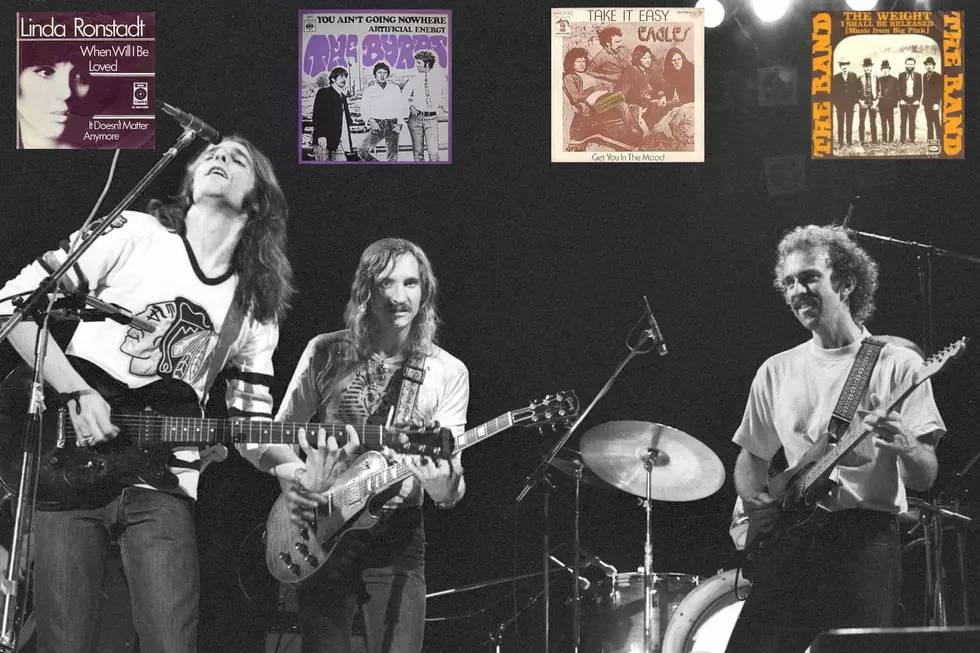
Top 35 Country Rock Songs
Unlike harder-leaning Southern rock, melody-based country rock sometimes takes a peaceful, easygoing route. Think Southern rock's jam-based songs rooted in the blues, gospel, and R&B, versus country rock's acoustic guitars, banjos, and song-oriented tunes.
No doubt it's a fine line — there aren't any tracks by Lynyrd Skynyrd in the list below of the Top 35 Country Rock Songs, but the Allman Brothers Band and the Marshall Tucker Band do appear. What makes a song country rock but not Southern rock? To borrow a colloquialism: You know it when you hear it.
The songs below, as voted on by UCR staff, span tracks from the genre's dawn in the late '60s to favorites that hit the official country charts and cuts that share traits with, yes, Southern rock. Nearly all trace their roots to early 20th-century American folk music, so it's little surprise that most of the artists come from the U.S. But rock 'n' roll's evolution and influence in the late '50s and early '60s shows they've come a long way from the back roads and front porch.
35. Linda Ronstadt, "You're No Good" (1974)
Linda Ronstadt took an 11-year-old song by Dee Dee Warwick (Dionne's sister), ran it by her ace live band (schooled in country rock) and launched a fledgling solo career with her only No. 1 single. Unlike the original take on the song, an R&B burner first charted by Betty Everett, Ronstadt's version takes on a rootsy pop edge, leading off Heart Like a Wheel, her breakthrough sixth LP and a country-rock milestone.
34. Crosby, Stills, Nash & Young, "Teach Your Children" (1970)
Graham Nash wrote "Teach Your Children" while he was still in the Hollies. He brought it to his new bandmates, David Crosby and Stephen Stills, for their debut album as a trio, but it didn't become a hit until Neil Young joined for the first Crosby, Stills, Nash & Young album, Deja Vu, in 1970. Jerry Garcia added pedal steel guitar, a return favor after the group taught harmonies to Grateful Dead for Workingman's Dead.
33. Nitty Gritty Dirt Band, "Mr. Bojangles" (1970)
Jerry Jeff Walker wrote "Mr. Bojangles" about a real person he met while serving time in jail for public intoxication. It's become a much-covered tune since Walker debuted his version in 1968. Nitty Gritty Dirt Band had a Top 10 hit in 1970 — accidentally changing some of the original lyrics — with the song, whose mix of banjo, mandolin, and accordion stayed true to the group's roots in traditional country, folk, and bluegrass.
32. Gram Parsons, "A Song for You" (1973)
Gram Parsons had already been dismissed from two groups (Flying Burrito Brothers, which he cofounded, and the Byrds) when he released his debut solo album, GP, in 1973. "A Song for You" is one of the album's most gorgeous tracks, a sorrowful love song to Parsons' Southern youth and to country music itself. Eight months after GP's release, he died of an overdose. The posthumous Grievous Angel followed.
31. The Ozark Mountain Devils, "Jackie Blue" (1974)
Springfield, Missouri-based Ozark Mountain Devils hit the Top 25 for the first time with "If You Wanna Get to Heaven." But their 1974 single "Jackie Blue" earned them a place in the country rock pantheon. The song was written about a drug dealer the band's drummer, Larry Lee, knew. Producer Glyn Johns, fresh from his work on the Eagles' first three albums, tightened the song for radio. It made it to No. 3.
READ MORE: Top 10 Southern Rock Songs
30. Creedence Clearwater Revival, "Proud Mary" (1969)
John Fogerty made Creedence Clearwater Revival hard to pin down from the start. Were they a garage band? A psychedelic band? A swamp-rock group? Or just a great pop combo? The answer is all of these, but with some detours. Its author conceived the perennial "Proud Mary" as many things, including a Stax tribute and a gospel song. Also in its late-'60s stew: a country rock shuffle open to musical interpretation.
29. Gram Parsons, "She" (1973)
Written with bassist Chris Ethridge, a fellow member of the International Submarine Band and the Flying Burrito Brothers, "She" was selected as the lead single from Gram Parsons' solo debut, GP. It didn't chart, but both the song and the album laid the groundwork for country rock's alt-country successor in the '90s. Like several songs on GP, "She" is a somewhat affectionate nod to the South where Parsons grew up.
28. Crosby, Stills, Nash & Young, "Ohio" (1970)
Crosby, Stills, Nash & Young had released their first album two months earlier when the Ohio National Guard shot and killed four students at a Vietnam War protest at Kent State University in May 1970. Neil Young quickly wrote down his thoughts and returned to the studio with his new bandmates to record a timely single. "Ohio," leaning toward the rock side of country rock, was an instant hit and one of the era's best protest songs.
27. Steve Earle, "Guitar Town" (1986)
Country rock was evolving into roots rock and Americana when Steve Earle released his debut album in 1986. But a clear line can be traced to the music's golden age on Guitar Town and its title track. For a while, it looked like the Texas-bred singer-songwriter would lead a new, less slick country music movement in Nashville. But a drug addiction derailed him in the early '90s until a career rebound later in the decade.
26. The Rolling Stones, "Sweet Virginia" (1972)
Right around the time Gram Parsons left the Byrds, he started hanging around with Keith Richards; for a time, they shared habits and influences. The Rolling Stones' Sticky Fingers includes two songs undoubtedly inspired by the future Flying Burrito Brothers: "Dead Flowers" and "Wild Horses," which Parsons' new group recorded in 1970. Parsons' country spirit later informed "Sweet Virginia" from Exile of Main St.
25. R.E.M., "(Don't Go Back To) Rockville" (1984)
It may sound like R.E.M. had a tongue-in-cheek take on this 1984 song, with Michael Stipe's mannered twang and a down-home country arrangement, but the Athens, Georgia, band knew the South inside and out. Guitarist Peter Buck has said "(Don't Go Back To) Rockville" was originally a punk song that bassist Mike Mills wrote for his girlfriend. But its route changed on the way to their second album, Reckoning.
24. Janis Joplin, "Me and Bobby McGee" (1971)
Kris Kristofferson was one of the most in-demand songwriters of the late '60s and early '70s, with "Sunday Morning Coming Down" (covered by Johnny Cash) and "For the Good Times" (Ray Price) becoming huge hits on the country charts. In 1970, Janis Joplin recorded "Me and Bobby McGee" the month before her October death; in early 1971, her posthumous album Pearl was released, and it became her only No. 1.
23. Creedence Clearwater Revival, "Up Around the Bend" (1970)
CCR's 18-month run starting in January 1969 with Bayou Country and ending with their masterpiece, Cosmo's Factory, in July 1970 yielded four great albums (including Green River and Willy and the Poor Boys). By the time they arrived at "Up Around the Bend" near the end of the run, frontman John Fogerty had sharpened his songs to their hitmaking point. It comes from the tougher side of the country-rock balance.
22. Bob Dylan, "Lay Lady Lady" (1969)
An argument can be made that Bob Dylan, as he has done many times throughout his long career, was at the vanguard of a movement that influenced generations of artists. With the 1967 Basement Tapes recordings, he and the Band made some of the first country-rock songs; his John Wesley Harding album from later that year is further evidence. Need more? 1969's Nashville Skyline and this hit single.
21. Outlaws, "Green Grass and High Tides" (1975)
With two extended guitar solos that push the song past the 10-minute mark, Outlaws' "Green Grass and High Tides" comes dangerously close to Southern rock in its resistance to country rock limits. (Truth be told, it's both Southern rock and country rock.) By the mid-'70s, most genre progenitors had moved on to rougher terrain; with their debut album and this most epic closing song, Tampa's Outlaws straddle the line.
20. J.J. Cale, "Call Me the Breeze" (1971)
J.J. Cale became a favorite of artists like Eric Clapton and Lynyrd Skynyrd, thanks to his debut album, Naturally, which helped stoke the "Tulsa sound" mix of blues, swamp and country rock. "Call Me the Breeze" is notable for its use of a primitive drum machine, leaving its spare arrangement open to interpretation. Skynyrd's 1974 cover ups the volume and intensity without losing the core of Cale's superb original.
19. The Band, "Up on Cripple Creek" (1969)
Even as the godfathers of Americana music, the Band rarely played to type. The first single from their eponymously titled second album, "Up on Cripple Creek," features Garth Hudson on clavinet with a wah-wah pedal. The sound — used in countless funk songs in the '70s — gives "Cripple Creek" its distinctive stamp as rootsy country rock rooted in blues and R&B while setting its sights on an approaching decade.
READ MORE: Top 100 Rock Songs of All Time
18. Flying Burrito Brothers, "Hot Burrito #1" (1969)
After helping the Byrds develop the country-rock template on 1968's Sweetheart of the Rodeo, Gram Parsons left the band, taking Chris Hillman with him. Within two months, they formed the Flying Burrito Brothers. Their 1969 debut, The Gilded Palace of Sin, further expanded the nascent genre's boundaries. The heartbreaking "Hot Burrito #1" is a highlight and a blueprint for '70s country rock.
17. Grateful Dead, "Friend of the Devil" (1970)
The Grateful Dead moved from a psychedelic band to a folk group on their fourth studio album, Workingman's Dead, in 1970; nine months later, they repeated the combination on American Beauty. Combining folk, country and bluegrass, the LPs helped set the standards of country rock in the early '70s. "Friend of the Devil," sung and cowritten by Jerry Garcia, highlights Beauty and the Grateful Dead's exemplary roots-leaning era.
16. Eagles, "New Kid in Town" (1976)
Four years after their self-titled debut album became a country-rock standard, the Eagles left behind most of the peaceful, easy feelings and replaced them with life in the fast lane. Their fifth album, Hotel California, wraps everything from hard rock to reggae to big, sweeping, strings-assisted ballads. The one song that recalls their country rock origins, "New Kid in Town," was the LP's lead single and a No. 1 hit.
15. The Rolling Stones, "Wild Horses" (1971)
Inspired by Gram Parsons, who was hanging out with Keith Richards, "Wild Flowers" borrows phrasing and tone from the country rock pioneer. When the Stones filed away their demo, thinking it wasn't very good, Parsons took it for the Flying Burrito Brothers' second album. Their version beat the Stones' reconsidered, and better, rendition (found on 1971's Sticky Fingers) to the shelves by more than a year.
14. The Rolling Stones, "Dead Flowers" (1971)
The Rolling Stones were moving on from the '60s as they continued work on what would become their first album of the new decade, Sticky Fingers. From the corners of American music — soul, blues and country — the album may be the most characteristic of the Stones' classic sound: keyed-in riffs beneath a sexy, defiant sway and swagger. "Dead Flowers" applies it to a country shuffle.
13. Eagles, "Already Gone" (1974)
With their third album, the Eagles broadened their audience. The pivot to the more rock-oriented terrain of On the Border didn't hurt their commercial prospects; in many ways, the album cleared the ground for their even more successful second act. The LP's first single and opening song, "Already Gone," skims the edge of Southern rock, with new guitarist Don Felder contributing a Skynyrd-like solo.
12. Creedence Clearwater Revival, "Bad Moon Rising" (1969)
Deceiving, in its near-rockabilly rhythm, is one of John Fogerty's most apocalyptic songs (and a Green River highlight), detailing an unknown approaching evil with a casualness that borders on bliss. The country-rock warning has soundtracked a share of movies, TV shows and video games over the years. Like four other Creedence Clearwater Revival singles denied the top spot, "Bad Moon Rising" stopped at No. 2 in 1969.
11. Linda Ronstadt, "When Will I Be Loved" (1974)
"When Will I Be Loved" was a hit for the Everly Brothers in 1960, but the Phil Everly-written song was even bigger for Linda Ronstadt when she covered it on her breakthrough album Heart Like a Wheel. Following the No. 1 "You're No Good," "When Will I Be Loved" became Ronstadt's second consecutive hit, peaking at No. 2. It did reach No. 1 on the country chart, though, a nod to its roots.
10. The Allman Brothers Band, "Midnight Rider" (1970)
Gregg Allman was determined to make "Midnight Rider" a hit, which first appeared on the Allman Brothers Band's second album, Idlewild South. He cowrote it with one of the group's roadies, and it got a second life (and a Top 20 chart showing) in 1973 on Allman's solo debut, Laid Back. The earlier take is the definitive version, with the band avoiding its usual jam habits for three minutes of blues-embedded country rock.
9. Eagles, "Lyin' Eyes" (1975)
By Eagles' fourth album in 1975, they had moved toward a more rock-oriented sound. But Glenn Frey's only lead vocal on One of These Nights still leaned heavily on the country elements of their early country-rock sound. "Lyin' Eyes" reached No. 2 on the pop chart and No. 8 on the country chart (the group's only Top 40 hit on that chart until a 2007 reunion LP) — no surprise, given its breezy acoustic melody and theme.
8. Neil Young, "Heart of Gold" (1972)
One of music's most restless artists had already made folk, pop, psychedelic and rock records by the time his fourth solo LP arrived in 1972. Harvest firmly planted Neil Young in country rock, with its lead single, "Heart of Gold," a career highlight. With backing vocals by Linda Ronstadt and James Taylor, the song hit No. 1 and heightened expectations among fans and at his label. He then swerved in a new direction.
7. Eagles, "Take It Easy" (1972)
Eagles sounded fully formed when their debut single, "Take It Easy," arrived in 1972. Various studio and road work (with Linda Ronstadt, among others) honed the original quartet to a finely tuned country-rock point. They weren't originators, but the Eagles soon became a benchmark. "Take It Easy" was cowritten by Glenn Frey and Jackson Browne, whose version appeared a year later. The Eagles' take is definitive.
READ MORE: Top 250 American Songs
6. Eagles, "Desperado" (1973)
"Desperado" was merely an album track and the title song to the Eagles' second album when it was released in 1973. But it soon became one of their most popular songs. An earlier Don Henley composition tailored to fit Desperado's Old West marauders theme, the song was musically based on Ray Charles' "Georgia on My Mind," right down to the sweeping strings. Linda Ronstadt's cover the same year boosted its value.
5. The Byrds, "You Ain't Goin' Nowhere" (1968)
The Byrds had launched their career in 1965 with a cover of Bob Dylan's "Mr. Tambourine Man." Four years later, as they were rewriting their history and poised to start anew, another Dylan song served as a trigger. Rebranding as a country rock band on Sweetheart of the Rodeo, the Byrds open the LP with Dylan's "You Ain't Goin' Nowhere," from the then-unreleased Basement Tapes he made with the Band.
4. Little Feat, "Willin'" (1972)
Little Feat's first attempt at "Willin'" wasn't very successful. Lowell George wrote the song for his band's self-titled 1971 debut album, and revisited it at a slower tempo on their second record, Sailin' Shoes. The result is a pillar of country rock and a road anthem about "weed, whites and wine" covered by Bob Dylan, Linda Ronstadt, and countless others over the years.
3. The Marshall Tucker Band, "Heard It in a Love Song" (1977)
For most of their career, South Carolina's Marshall Tucker Band could be classified as Southern rock (see their classic "Can't You See"). But "Heard It in a Love Song" straddles the line between country and rock, with pop-minded musicality. It's not just the masterful flute that runs throughout the song or Doug Gray's sympathetic vocal (has a goodbye song ever sounded so warm?). This is '70s song-making at its finest.
2. The Band, "The Weight" (1968)
The Band were architects of the country-rock sound, alongside their partner in crime, Bob Dylan, during 1967's extended vacation that resulted in The Basement Tapes. Still sharpening their sound, they made their debut, Music From Big Pink (which featured some of the songs laid down in the Woodstock, New York, house with Dylan), and hit on an instant classic with "The Weight," a parable as aged as the folk tunes it invokes.
1. The Band, "The Night They Drove Old Dixie Down" (1969)
Everything about the Band's second, self-titled album points to the beginnings of Americana music — from the sepia-toned cover photo by Elliott Landy to Robbie Robertson's songs about faith, redemption and repentance, performed on instruments that could date back a hundred years. No song captures this atmosphere more than "The Night They Drove Old Dixie Down," set in the final year of the Civil War and delivered in a dust-ravaged voice by Levon Helm. On its own, the song stands as one of Robertson's and the group's greatest achievements; as The Band's conceptual center, the track links the fading-but-still-in-view past to the bridge between country and rock music as they progress further into the 20th century.
The 12 Worst Bob Dylan Albums
Gallery Credit: Michael Gallucci
 Source: Top 35 Country Rock Songs

